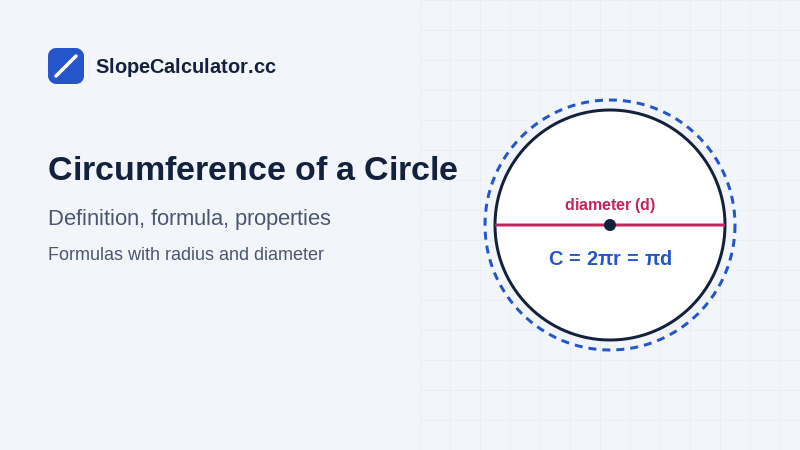
Take a bicycle wheel, a roll of tape, or a dinner plate. Wrap a piece of string around its outer edge. The length of that string is the circumference. In geometry, circumference is the perimeter of a circle. When you walk around a fence, you measure perimeter. When you measure around a circle, you find circumference.
Understanding how to calculate circumference is useful in daily life. You use it in crafts, running track design, and sports. When constructing circular running paths or curved ADA ramps, builders pair perimeter measurements with our slope percentage calculator. In this guide, we explore the clear definition of circumference. We explain why pi never changes. We show both main formulas. We also show how to find circumference from area. Finally, we work through four full examples with real units.
What is circumference in plain English
A circle contains all points that are the same distance from a center dot. That distance from the center to the rim is the radius (r). The distance straight across the center is the diameter (d). The diameter is always twice as long as the radius:
The circumference (C) is the total distance around the curved edge. Imagine a tiny ant walking along the rim of a coin until it returns home. The length of that ant walk equals the circumference. When you need quick answers for circles of any size, you can calculate them instantly using our circumference calculator.
The constant pi and why it never changes
Thousands of years ago, ancient builders noticed a surprising rule. No matter how big or small a circle is, dividing its perimeter by its width gives the same ratio. A tiny coin and a huge wagon wheel share this exact number:
This ratio is named π (the Greek letter pi). Pi is an irrational number. Its decimals go on forever without ever settling into a repeating pattern. For homework problems, using 3.14159 or the fraction 22/7 works well.
Because this ratio never changes, we can rearrange (C / d) = π to write our formulas.
The two main circumference formulas
You can find circumference from the diameter or the radius:
1. Using diameter
When you know the diameter (d), the circumference is:
This is a one-step formula. You multiply the width across the circle by π.
2. Using radius
Diameter is twice the radius (d = 2r). Putting 2r in place of d gives:
Both formulas give the exact same answer. If you have the radius, double it and multiply by π. If you have the diameter, multiply by π directly.
Calculating circumference from circle area
Sometimes you know the flat surface area instead of the width. The formula for the area (A) of a circle is:
To find circumference from area, follow these two algebraic steps:
- Solve for the radius (r): Divide the area by π. Then take the square root:
r = √((A / π))
- Substitute r into the circumference formula:
C = 2πr = 2π√((A / π)) = 2√(πA)
This formula lets you move directly from area to perimeter.
Four worked examples with units
Here are four complete worked problems showing how to find circumference:
Example 1: Finding circumference from radius
Find the circumference of a round garden pond with a radius of 7 cm.
- State the radius: r = 7 cm.
- Use the radius formula: C = 2πr.
- Plug in 7 cm:
C = 2 · π · 7 = 14π cm
- Find the decimal value:
C ≈ 14 · 3.1415927 ≈ 43.98 cmThe pond rim measures about 43.98 cm around.
Example 2: Finding circumference from diameter
A bicycle wheel has an outer diameter of 20 inches. How far does the bicycle roll in one wheel turn?
- One full turn equals one circumference.
- Given diameter: d = 20 inches.
- Use the diameter formula: C = πd.
- Plug in 20:
C = π · 20 = 20π in
- Multiply by 3.14159:
C ≈ 20 · 3.14159 ≈ 62.83 inchesEach complete turn rolls the bicycle forward by about 62.83 inches.
Example 3: Finding radius from a known circumference
A circular running track has a boundary measuring 31.42 meters. What is the radius?
- Write the formula: C = 2πr.
- Insert the known circumference:
31.42 = 2πr
- Divide both sides by 2π (about 6.28318):
r = (31.42 / 6.28318) ≈ 5 metersThe radius of the track is 5 meters. If you have the coordinates of the track center and an outer boundary marker, you can find the exact radius using our distance calculator.
Example 4: Finding circumference from an area
A circular pizza pan covers an area of 78.54 square inches. Find the length of its outer rim.
- Use the area formula to find radius:
r = √((A / π)) = √((78.54 / 3.14159)) = √(25) = 5 inches
- Calculate the circumference from radius:
C = 2π(5) = 10π ≈ 31.42 inchesThe outer rim measures 31.42 inches long.
How to find the perimeter of a semicircle
A semicircle is half of a circle. Finding its perimeter takes two steps.
First, calculate half of the circle’s circumference. For a full circle, circumference is π times diameter. So the curved arch has length (πd) / 2.
Second, add the flat straight bottom edge. The flat bottom edge is the diameter d.
Adding the curved arch and the flat diameter gives the total perimeter:
For example, suppose a semicircle has a diameter of 10 cm. The curved top arch is (π × 10) / 2 = 5π ≈ 15.71 cm. The flat bottom edge is 10 cm. The total perimeter is 15.71 + 10 = 25.71 cm.
Many students forget to add the flat bottom edge. They only calculate the curved top. Always remember that a perimeter must enclose the whole shape.
Measurements of common circular objects
Seeing real objects helps build an intuitive grasp of how radius, diameter, and circumference connect:
| Circular Object | Typical Radius | Typical Diameter | Circumference (≈) | Primary Formula Used |
|---|---|---|---|---|
| Soda can top | 1.3 in (3.3 cm) | 2.6 in (6.6 cm) | 8.2 in (20.7 cm) | C = πd |
| Compact disc (CD/DVD) | 6 cm (2.36 in) | 12 cm (4.72 in) | 37.7 cm (14.8 in) | C = 2πr |
| Regulation basketball hoop | 9 in (22.9 cm) | 18 in (45.7 cm) | 56.5 in (143.6 cm) | C = πd |
| Vehicle steering wheel | 7 in (17.8 cm) | 14 in (35.6 cm) | 44 in (111.8 cm) | C = πd |
| Ferris wheel (standard) | 30 ft (9.1 m) | 60 ft (18.3 m) | 188.5 ft (57.5 m) | C = 2πr |
Common mistakes when calculating circumference
Keep an eye out for these frequent mistakes on tests:
- Mixing up radius and diameter: Do not plug a diameter into 2πr. If diameter is 10, the radius is 5. Using 10 makes your answer twice as large as it should be.
- Confusing circumference with area: Circumference measures distance around the rim (C = 2πr). Area measures the flat space inside (A = πr²). Never use square units for circumference.
- Rounding pi too early: Rounding π to 3.1 too soon causes errors. Keep full decimals in your calculator until your final step.
- Writing square units: Circumference is a distance. Always use linear units like inches or centimeters.
Circumference FAQs
Why is circumference considered a special case of perimeter?
Perimeter is the total boundary distance around any flat shape. For shapes with straight edges, you add up the individual side lengths. For circles, the boundary is one continuous smooth curve. Mathematicians give this circular boundary its own distinct name: circumference.
Is the circumference of a circle always longer than its diameter?
Yes. The circumference is always π times longer than the diameter. That is roughly 3.1416 times greater. Walking around a circular fountain takes more than three times as many steps as walking straight across its center.
Can circumference be expressed as an exact number?
Yes. Leaving π as a symbol gives an exact value, such as 14π cm. Writing 14π preserves exact arithmetic without rounding errors. Replacing π with 3.14 gives an approximation useful for building and real-world construction.
What is the relationship between a circle’s circumference and a tangent line?
A tangent line touches a circle’s outer circumference at exactly one point. At that point of contact, the tangent line forms a perpendicular 90-degree right angle with the circle’s radius. You can explore line steepness with our slope calculator or learn what slope represents with step-by-step examples.
How does doubling the radius affect the circumference?
Doubling the radius doubles the circumference. If a circle with radius 3 has circumference 6π, doubling radius to 6 gives 12π. This direct linear relationship occurs because circumference is proportional to radius. In contrast, its area grows four times larger because area depends on the square of the radius.